Visualizzazione post con etichetta francis bacon. Mostra tutti i post

domenica 27 settembre 2015

Interview with Red Tweny

 
Hello Red Tweny,

Thank you for granting me this interview! The first question that comes to my mind is: why Red Tweny? Does it have a particular meaning?

Hi Maurizio, and thank you for your interest. So…why Red Tweny? Well, I chose “Red” because I couldn't find a shorter name – admitting that it's a real name -, because it reminds me of the name Rhett (the amusing male protagonist of Gone With The Wind, i.e. Clark Gable), and also because the colour red contrasts hugely with my black-and-white subjects. As to Tweny, it is a contraction of twenty freely inspired by twenty-two (22), a number that often recurs in my life, on occasions both lucky and unlucky. 
 

How was your passion for drawing born? Do you think that some particular events prompted you to embrace this passion?

I have no recollections of particular events which prompted me to draw... it has always come naturally to me since the times when I drew on the desks at school. I drew with Bic pens and the lines that I trace today on large-format sheets are more or less the same that I drew on the smaller space of a green Formica-topped desk support. Later on, the cleaning lady would wipe the desk clean, and the day after I would find a new drawing "sheet". When I was a kid there was plenty to be inspired by: as I was a bit smaller than my classmates, both physically and emotionally, I always felt a little like an outcast. The many and untimely delusions of love together with a sanctimonious and stifling family education were the icing on the cake: monsters and writhing à gogo! While as a teenager friends and family harshly hurt my feelings, today I aim to voice those sufferings and aspirations in a human soul which are often denied. I cannot help but see how, inside of me and around me, suffering and unease envelop us, no one excluded. Such increase of a feeling of malaise in the current human condition is all too evident to me and is in stark contrast with the quantity of objects and things we have at our disposal as compared even only to fifty years ago. I am unable to provide explanations, let alone cures: I only voice these feelings through my drawings.


How has your art changed over time? Were you particularly inspired by somebody at the beginning? Was it difficult to develop a unique and personal style or was it somehow an automatic, spontaneous process?

Let's say that I haven't always been constant. I started drawing seriously (that is, with a view to organising exhibitions and selling my work) when I was 19 and went on until 25 to take it up again about 10 years ago, at the dawn of my 40th year, spurred by a friend of mine who works as a publisher. My favourite subjects were and are faces, that is where I most successfully manage - or so it seems to me, at least - to condense the essence of my moods and sensations. The essence of my work resides there and I don't feel the urge to go beyond that. I understand, however, that one risks becoming monotonous, so, three or four years ago, I started alternating the faces with more complex images where bodies and odd anthropomorphic beings move, lie down, sit down or hurl themselves into the space while still remaining twisted or partly curved in on themselves. It's not easy because the sheet always appears to me too small for such subjects, but I feel the need to tackle such images once in a while.
With respect to my style, I didn't consciously meditate on it, it was rather a natural process. Later on, over the years, I realised that I was quite a unique specimen in the almost endless artistic context that Internet provides us with and I managed to assert my position there. Later I became aware that drawing with India ink also presents several practical and positive aspects: it's cheap, doesn't make you dirty and if you have to send a piece of yours by post you can roll it into a tube and send it by DHL as far as to the USA with 25 euros. That'd be impossible with an oil painting.

Normally, how long do you take to make a drawing?

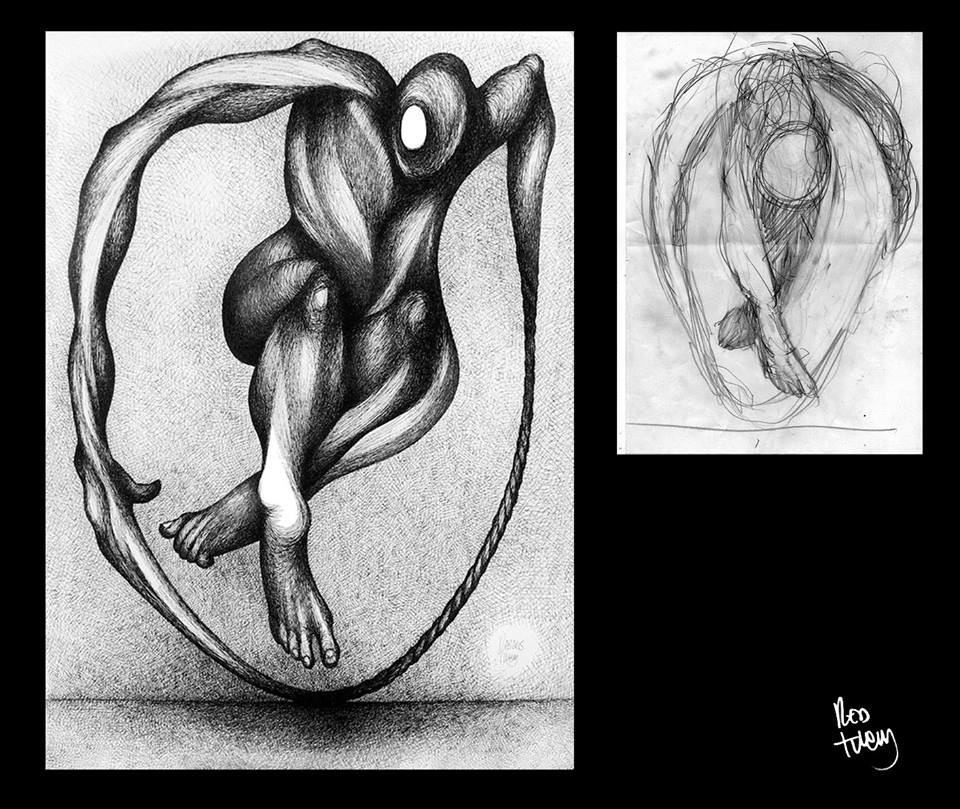
The making of a work of mine envisages two distinct phases: sketching the piece with pencil on a A4 sheet of paper and drawing the final version with India ink pen on a large-format sheet (50x70 cm).
As to the sketching phase, times vary: I can spend a whole week doodling without producing nothing significant or I can make four or five sketches in an hour. It's a matter of being in tune and inspired, of silences and lights, of chance and feelings experienced recently. One thing is for sure, and that is that I have made a lot of sketches which I have put aside, so I have in "store" a lot of drawings to reproduce on large-format sheets, rigorously 50x70 cm. Once I have chosen the base sketch, I proceed to draw utilising the India ink, usually with a 0,3 mm point pen. Here the times are more precise: about two hours a day for seven days, it cannot take less than that. I am set on producing at least one work per week: I have to and I want to, because I think that constancy pays.


I know that you greatly admire Francis Bacon. What do you find particularly fascinating about his work? Are there any literary figures who influenced your work indirectly in the attempt to evoke a certain mood? If not, are you used to listening to music while working and are there certain tracks or music genres that allow you to work better?

With regard to Bacon, I admire his perfect representation of the modern malaise of the human condition. The use and juxtaposition of bright and "frivolous" colours with sudden and implausible shadows is both disconcerting and brilliant. What is strikingly evident is the representation of human loneliness during moments of common life in settings which you'd never think to utilise for an artwork. His torn and decomposed faces convey innumerable concepts: our caducity, our suffering, the monster that is in all of us. However, several essays have been written on Bacon and it would be foolish of me to exert criticism. Personally, he's the only artist who stimulates me to draw every time I see his work. But I have to confine myself to a few glimpses not to risk being influenced....it'd be problematic!
I never listen to music while I draw in the evening but at 9 pm I tune into Focus channel with the hope of coming across a programme on outer space and physics: nothing better than that to roam freely a bit and remember how small we are, and only passing through. Music would engross me too much, and I wouldn't be able to concentrate on drawing... I don't know why, but Focus programmes are ideal for drawing and simultaneously thinking of features that somehow come up in my drawings: have you noticed how many spirals and orbits appear in them?
As to reading, I confess that the last author I read, at a early age, was Edgar Allan Poe; at a later time, life, work, family, and all the other activities have prevented me from cultivating a reading habit: simply enough, I have no time to dedicate to reading a good book; you can't do everything in your life!


In your drawings, white, black, and all the hues of grey are used to give depth to goggle-eyed figures wrenching in implausible twists which still retain a precise and flawless plasticity. However, I'd like to ask you: do you also enjoy experimenting with colour? Do you find it more difficult to obtain the same effects?

Illustrators and painters cannot forget about colour, for pity's sake, I'm perfectly aware of it. However, in my case, working with colour would entail a huge slowdown in my production. I'm looking forward to creating the “perfect” subject that I haven't yet managed to produce. I made some colour drawings with India ink which I don't have anymore nor have I photographs of them, but the time required to make them is ten times as long and I have no “time to lose”! One of my goals is to have 400/500 pieces in my gallery and, considering that I don't want to make pieces that look similar or present only slight variations, you can understand that I cannot dedicate two or three weeks "only" to colour my pieces (I'd always utilise India ink pens, no gouache or watercolour techniques). After all, you can recognise my pieces at first sight also because of this chromatic characteristic, although I'm certainly not the only one who tackles B&W! Besides, I know myself and I know that I'd have the tendency to fill all the spaces with colour, thus distracting the viewer's eye from the core message. In any case, I don't exclude colour a priori, but the time hasn't come yet.


How much do you draw upon reality and how much upon imagination?

When I can find the right moment and the ideal situation to jot down a sketch, my rational side turns off and I almost go into a trance. Consequently, it's difficult for me to rationally determine what and how much I draw upon. Shall we say 50% each?
I'm not a fan of abstract art, surrealism or hyperrealism for the sake of it. I only like something about each of these styles and I try to combine them. Of course, even in this respect, Bacon was a master.


I agree with you when you say that your style is extremely personal and recognisable. In this sense, do you think that originality always pays or sometimes it occurs to you that perhaps it'd be easier to follow a certain trend, walk down the beaten path, be part of a group which has certain guidelines?

The answer is easy. Luckily, since I don't make a living selling my works, I am free to walk down my own path without making any compromises. In any case, following a certain trend would be no guarantee of success…and, in everyday's chaotic situation, who could determine which is the current "trend"? I don't participate to art-related events nor have I acquaintances in the art world, but I have the impression that, unlike what happens with articles of clothing in the fashion world, there are no longer trends or specific currents: everybody dresses the way they want and in the colours they like.
What is crucial now is to voice the age we live into and manage to strike a chord with the viewer. There, that is the only way in which I want to be fashionable, depicting the crude, scary and by now out-of-control social and ethical chaos which frightens us and makes us writhe out of angst and fear, from the United States up to China.


Where are your works available for purchase?

My American curator is based in Switzerland and promotes my work in that area, her name is Julie Draper: http://www.drapercontemporary.com. For the Italian friends, I can take care of it: (redtweny@gmail.com)!


Thanks for your time!

Thanks to you, Maurizio, I feel honoured.

Other links on Red Tweny:
 

***

If you like “Leisure Spot” and its free content, make a small donation via PayPal or Ko-fi to support the blog.


mercoledì 21 gennaio 2015

Intervista a Red Tweny

For my translation of the interview into English: http://leisurespotblog.blogspot.it/2015/09/interview-with-red-tweny.html

Ciao Red Tweny,

Grazie per avermi concesso quest'intervista! La prima domanda che mi viene spontaneo farti è: perché Red Tweny? Ha un significato particolare?

Ciao Maurizio e grazie a te per il tuo interessamento. Allora…perché Red Tweny? Allora, “Red” perché un nome – ammesso che sia un nome - più corto non c’è, perché mi ricorda il nome di Rhett (il simpatico protagonista maschile di Via col Vento, leggi Clark Gable) e perché il colore rosso è grandemente in contrasto con i miei soggetti in bianco e nero. Tweny invece nasce dalla contrazione di twenty, liberamente ispirato dalla traduzione inglese di twentytwo (22), un numero che ricorre spesso nella mia vita, in occasioni fortunate e sfortunate.

Da dove nasce la tua passione per il disegno? Credi che qualche evento in particolare ti abbia spinto in questa direzione?

Non ricordo eventi particolari che mi hanno spinto a disegnare…mi viene naturale da quando disegnavo sui banchi di scuola. Disegnavo con le Bic su di loro ed i segni che oggi riproduco su grandi formati sono più o meno gli stessi che disegnavo in piccolo sui supporti di formica verde dei banchi; poi la signora delle pulizie nel pomeriggio puliva tutto ed io trovavo il giorno dopo un nuovo “foglio” da disegnare. Le ispirazioni da ragazzino non mancavano: ero un po' più piccolo degli altri miei compagni sia fisicamente che emotivamente e mi sentivo sempre un po' emarginato. Le tante e premature delusioni d'amore insieme ad un'educazione familiare bacchettona e soffocante fecero il resto: mostri e contorcimenti a go-go! Se da adolescente amichetti e famiglia urtavano violentemente la mia sensibilità, oggi mi faccio interprete delle sofferenze e delle aspirazioni - spesso negate - all'animo umano. Non posso non vedere come dentro di me e intorno a me la sofferenza ed il disagio avvolgano tutti noi, nessuno escluso. Questo aumento del malessere dell'attuale condizione umana mi è troppo evidente ed è in stridente contrasto con la quantità di oggetti e cose che tutti noi possiamo disporre rispetto solo a cinquant'anni fa. Non so dare spiegazioni né ovviamente cure: me ne faccio solo interprete disegnandolo.


Com'è cambiata la tua arte nel corso del tempo? Ti ispiravi a qualcuno in particolare agli inizi? È stato difficile approdare a uno stile unico e personale o in qualche modo si è trattato di un processo automatico, spontaneo?

Diciamo che non sono stato molto costante nel tempo. Ho iniziato a disegnare seriamente (cioè con l’intento di fare mostre e vendere i miei lavori) tra i 19 ed i 25 anni e poi ho iniziato di nuovo – spinto da un mio amico editore – circa 10 anni fa, all’alba dei miei 40 anni. Il mio soggetto preferito erano e rimangono i volti dove riesco - o almeno mi sembra - di poter concentrare tutta l’essenza dei miei umori e sensazioni. È lì l’essenza dei miei lavori e non sentirei l’esigenza di andare oltre. Capisco che però si rischia di essere monotoni ed ho iniziato tre-quattro anni fa ad intercalare ai volti anche situazioni un po’ più complesse dove corpi e strani esseri antropomorfi si muovono, si sdraiano, si siedono o provano a slanciarsi rimanendo però sempre contorti o piegati in parte su se stessi. Non è facile perché il foglio mi sembra sempre troppo piccolo per questi soggetti, ma devo cimentarmi ogni tanto con queste situazioni.

Per quanto riguarda la scelta del mio stile non è stata una scelta meditata ma si è trattato di un processo naturale. Poi nel tempo mi sono reso conto di essere abbastanza un unicum nel quasi infinito contesto artistico che il web ci propina e l’ho consolidato. Poi mi sono accorto che disegnare con la china ha anche molti aspetti pratici e positivi: è economico, non sporca e se devi spedire un tuo pezzo lo puoi intubare e con 25 Euro lo puoi spedire con DHL fino negli USA, impossibile con un opera ad olio.

Di norma, quanto tempo impieghi per realizzare un disegno?

La produzione di un mio lavoro prevede due momenti ben distinti: la progettazione del pezzo attraverso un bozzetto a matita su un piccolo formato A4 e la sua realizzazione con la penna a china su grande formato (50x70 cm).

Per il bozzetto i tempi sono variabili: posso passare una settimana a scarabocchiare senza produrre nulla di significativo come posso realizzarne quattro o cinque in un’ora. È questione di sintonia ed ispirazione, di silenzi e luci, di casualità e sensazioni vissute nel recente. Certo è che nel tempo ho prodotto tanti bozzetti che tengo da parte, quindi ho in “cascina” molti disegni da realizzare sul grande formato, rigorosamente 50x70 cm. Una volta selezionato il bozzetto di base procedo alla sua stesura e realizzazione con la china (uso quasi sempre una punta da 0,3 mm). Qui i tempi sono più precisi: circa due ore al giorno per 7 giorni, non si scampa. In questo sono abbastanza preciso nel produrre almeno un pezzo la settimana: lo devo e lo voglio, anche perché penso che la costanza paghi.


So che apprezzi molto Francis Bacon. Cosa ti affascina in particolare della sua opera? Ci sono delle personalità letterarie che indirettamente hanno influenzato il tuo lavoro nella costruzione di una determinata atmosfera? Oppure, se hai l'abitudine di ascoltare la musica mentre sei all'opera, ci sono dei brani o dei generi musicali che ti fanno lavorare meglio?

Di Bacon ammiro la perfetta rappresentazione del moderno malessere della condizione umana. È sconcertante e splendido l’uso e il drammatico accostamento di colori assolutamente brillanti e “frivoli” con il nero delle improvvise ed improbabili ombre. È lampante la rappresentazione della solitudine umana raffigurata durante momenti del viver comune in ambienti che mai penseresti di utilizzare per un opera d’arte. I suoi volti lacerati e decomposti comunicano innumerevoli concetti: la nostra caducità, la nostra sofferenza, il mostro che è in tutti noi. Ma sono stati scritti innumerevoli saggi su Bacon, ed è sciocco che io mi metta a fare la critica. Personalmente è l’unico artista che mi dà, ogni volta che appena lo vedo, uno stimolo a disegnare qualcosa di nuovo. Ma devo limitarmi solo a sbirciarlo per qualche secondo per non rischiare di rimanerne influenzato…sarebbe un guaio!!

Mentre disegno la sera non ascolto musica ma mi sintonizzo dalle 21:00 in poi su Focus (canale 56) nella speranza di ascoltare qualche trasmissione sul cosmo e sulla fisica: niente di meglio per spaziare un pò e ricordarmi quanto siamo piccoli e di passaggio. La musica mi assorbirebbe troppo, e non riuscirei a concentrarmi abbastanza sul disegno….non so perché ma invece le trasmissioni di Focus sono per me l’ideale per disegnare ma nello stesso tempo pensare e riflettere su elementi che poi in qualche modo si riflettono sui miei disegni: notato quante spirali e orbite ci sono dentro di loro?

Per la lettura confesso che mi sono fermato, in tenera età, alle letture di Edgar Allan Poe; poi la vita, il lavoro, la famiglia e tutto il resto degli impegni mi hanno impedito di coltivare questa attività: non ho materialmente tempo per dedicarmi alla lettura di un buon libro; non si può fare tutto nella vita !

Nei tuoi disegni il bianco, il nero e tutti i toni del grigio vengono usati per dare profondità a figure stralunate e distorte in torsioni impossibili, ma sempre precise e impeccabili nella loro plasticità. Vorrei però chiederti: ti piace anche sperimentare con il colore? Ti risulta più difficile ottenere gli stessi effetti?


Chi disegna o pittura non può dimenticarsi del colore, per carità, lo so. Ma nel mio caso e con la mia tecnica vorrebbe dire rallentare enormemente la produzione, ed io sono avido di creare il soggetto “perfetto” che non sono ancora riuscito a produrre. Ho già prodotto soggetti a colori con la china (che purtroppo non ho più e non ho neanche fotografato) ma il tempo per la loro realizzazione decuplica ed io non ho più “tempo da perdere”! Ho tra le altre cose l’obiettivo di arrivare ad avere almeno 400/500 pezzi nella mia galleria e dato che non amo fare pezzi che si rassomigliano o che introducono solo qualche variazione, capisci che non posso impegnare 2 o 3 settimane per introdurre “solo” del colore ai miei pezzi (utilizzerei sempre penne a china, non tecniche di gouache o acquerello). In fondo poi i miei pezzi sono immediatamente riconoscibili anche per questa caratteristica cromatica, nonostante non mi sembra di essere l’unico che si cimenti con il B&W! Conoscendomi so che poi tenderei a riempire tutti gli spazi con il colore distraendo l’occhio dello spettatore dal messaggio centrale. In ogni caso non escludo a priori il colore, ma non è ancora il momento.

Quanta realtà penetra nei tuoi disegni e quanta pura fantasia?

Quando riesco a trovare il momento e la situazione ideale per buttare giù un bozzetto la parte razionale si spegne e vado quasi in trance, quindi mi è difficile stabilire razionalmente quanto e cosa penetra nei miei soggetti. Diciamo 50 e 50?

Non amo l’astratto, il surrealismo o l’iperrealismo fine a se stessi. Mi piace solo qualcosa di questi stili e cerco sommariamente di coniugarli. Anche in questo Bacon era – ovviamente – un maestro.

Sono d'accordo con te quando dici che il tuo stile è estremamente personale e riconoscibile. In questo senso, credi che l'originalità paghi sempre o a volte ti capita di pensare che forse sarebbe più facile accodarsi a una determinata moda, seguire vie già consolidate, fare parte di un gruppo che si dà determinate linee guida?

È semplice la risposta: fortunatamente non vivo con la vendita dei miei lavori, quindi posso permettermi di percorrere la mia strada senza scendere a compromessi. In ogni caso non sarebbe una soluzione con garanzia di successo quella di accodarsi ad una determinata moda…. e poi nel caos di oggi chi potrebbe stabilire quale è la “moda” attuale? Non conosco e non frequento il mondo dell’arte, ma ho l’impressione che non ci siano più mode o correnti precise come nel mondo della moda per l’abbigliamento: ognuno si veste come gli pare e con i colori che gli pare. Ora l’importante è farsi interpreti del tempo che si vive e riuscire a toccare le corde dell’osservatore. Ecco, in questo credo e voglio essere molto alla moda, cercando di rappresentare il crudo, spaventoso e ormai incontrollabile attuale caos sociale ed etico che ci atterrisce e ci fa contorcere dall’ansia e dalla paura a partire dagli Stati Uniti fino ad arrivare in Cina.

Dov'è possibile acquistare le tue opere?

Ho una curatrice americana che opera in Svizzera e promuove in quella zona i miei lavori, si chiama Julie Draper (www.drapercontemporary.com). Per gli amici italiani invece posso fare da me (redtweny@gmail.com)!


 Grazie ancora per il tuo tempo!

Grazie a te Maurizio, onorato.
Altri link su Red Tweny:


***

Se “Leisure Spot” e i suoi contenuti gratuiti ti piacciono, fai una piccola donazione tramite PayPal o Ko-fi per supportare il blog.