domenica 27 settembre 2015

Interview with Red Tweny

 
Hello Red Tweny,

Thank you for granting me this interview! The first question that comes to my mind is: why Red Tweny? Does it have a particular meaning?

Hi Maurizio, and thank you for your interest. So…why Red Tweny? Well, I chose “Red” because I couldn't find a shorter name – admitting that it's a real name -, because it reminds me of the name Rhett (the amusing male protagonist of Gone With The Wind, i.e. Clark Gable), and also because the colour red contrasts hugely with my black-and-white subjects. As to Tweny, it is a contraction of twenty freely inspired by twenty-two (22), a number that often recurs in my life, on occasions both lucky and unlucky. 
 

How was your passion for drawing born? Do you think that some particular events prompted you to embrace this passion?

I have no recollections of particular events which prompted me to draw... it has always come naturally to me since the times when I drew on the desks at school. I drew with Bic pens and the lines that I trace today on large-format sheets are more or less the same that I drew on the smaller space of a green Formica-topped desk support. Later on, the cleaning lady would wipe the desk clean, and the day after I would find a new drawing "sheet". When I was a kid there was plenty to be inspired by: as I was a bit smaller than my classmates, both physically and emotionally, I always felt a little like an outcast. The many and untimely delusions of love together with a sanctimonious and stifling family education were the icing on the cake: monsters and writhing à gogo! While as a teenager friends and family harshly hurt my feelings, today I aim to voice those sufferings and aspirations in a human soul which are often denied. I cannot help but see how, inside of me and around me, suffering and unease envelop us, no one excluded. Such increase of a feeling of malaise in the current human condition is all too evident to me and is in stark contrast with the quantity of objects and things we have at our disposal as compared even only to fifty years ago. I am unable to provide explanations, let alone cures: I only voice these feelings through my drawings.


How has your art changed over time? Were you particularly inspired by somebody at the beginning? Was it difficult to develop a unique and personal style or was it somehow an automatic, spontaneous process?

Let's say that I haven't always been constant. I started drawing seriously (that is, with a view to organising exhibitions and selling my work) when I was 19 and went on until 25 to take it up again about 10 years ago, at the dawn of my 40th year, spurred by a friend of mine who works as a publisher. My favourite subjects were and are faces, that is where I most successfully manage - or so it seems to me, at least - to condense the essence of my moods and sensations. The essence of my work resides there and I don't feel the urge to go beyond that. I understand, however, that one risks becoming monotonous, so, three or four years ago, I started alternating the faces with more complex images where bodies and odd anthropomorphic beings move, lie down, sit down or hurl themselves into the space while still remaining twisted or partly curved in on themselves. It's not easy because the sheet always appears to me too small for such subjects, but I feel the need to tackle such images once in a while.
With respect to my style, I didn't consciously meditate on it, it was rather a natural process. Later on, over the years, I realised that I was quite a unique specimen in the almost endless artistic context that Internet provides us with and I managed to assert my position there. Later I became aware that drawing with India ink also presents several practical and positive aspects: it's cheap, doesn't make you dirty and if you have to send a piece of yours by post you can roll it into a tube and send it by DHL as far as to the USA with 25 euros. That'd be impossible with an oil painting.

Normally, how long do you take to make a drawing?

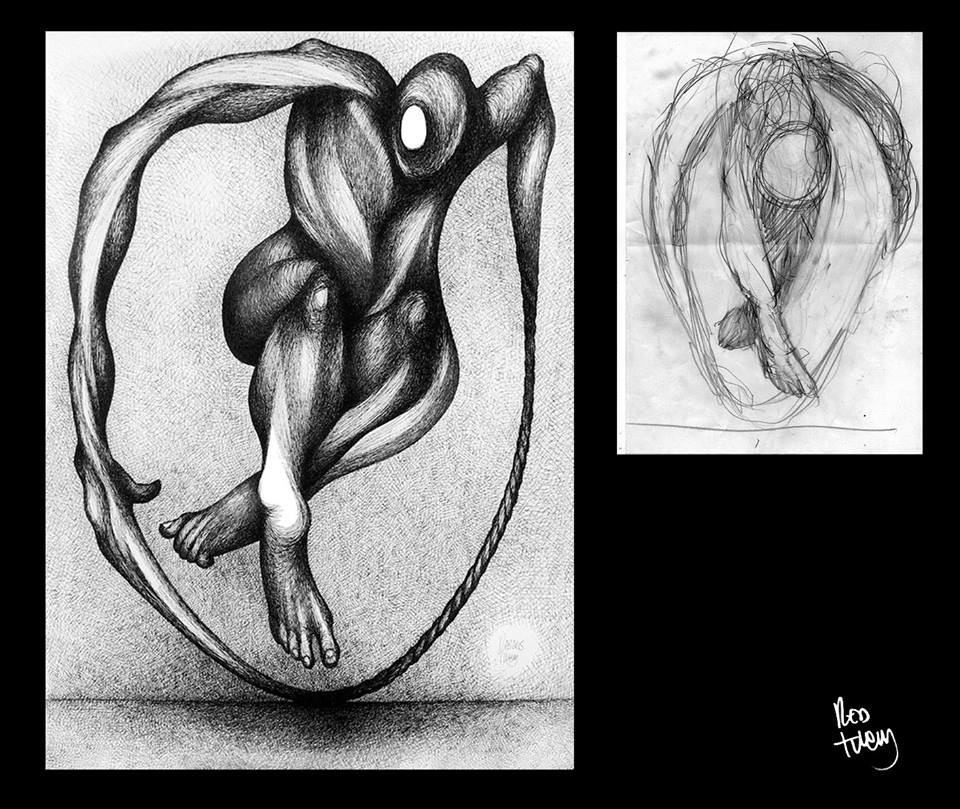
The making of a work of mine envisages two distinct phases: sketching the piece with pencil on a A4 sheet of paper and drawing the final version with India ink pen on a large-format sheet (50x70 cm).
As to the sketching phase, times vary: I can spend a whole week doodling without producing nothing significant or I can make four or five sketches in an hour. It's a matter of being in tune and inspired, of silences and lights, of chance and feelings experienced recently. One thing is for sure, and that is that I have made a lot of sketches which I have put aside, so I have in "store" a lot of drawings to reproduce on large-format sheets, rigorously 50x70 cm. Once I have chosen the base sketch, I proceed to draw utilising the India ink, usually with a 0,3 mm point pen. Here the times are more precise: about two hours a day for seven days, it cannot take less than that. I am set on producing at least one work per week: I have to and I want to, because I think that constancy pays.


I know that you greatly admire Francis Bacon. What do you find particularly fascinating about his work? Are there any literary figures who influenced your work indirectly in the attempt to evoke a certain mood? If not, are you used to listening to music while working and are there certain tracks or music genres that allow you to work better?

With regard to Bacon, I admire his perfect representation of the modern malaise of the human condition. The use and juxtaposition of bright and "frivolous" colours with sudden and implausible shadows is both disconcerting and brilliant. What is strikingly evident is the representation of human loneliness during moments of common life in settings which you'd never think to utilise for an artwork. His torn and decomposed faces convey innumerable concepts: our caducity, our suffering, the monster that is in all of us. However, several essays have been written on Bacon and it would be foolish of me to exert criticism. Personally, he's the only artist who stimulates me to draw every time I see his work. But I have to confine myself to a few glimpses not to risk being influenced....it'd be problematic!
I never listen to music while I draw in the evening but at 9 pm I tune into Focus channel with the hope of coming across a programme on outer space and physics: nothing better than that to roam freely a bit and remember how small we are, and only passing through. Music would engross me too much, and I wouldn't be able to concentrate on drawing... I don't know why, but Focus programmes are ideal for drawing and simultaneously thinking of features that somehow come up in my drawings: have you noticed how many spirals and orbits appear in them?
As to reading, I confess that the last author I read, at a early age, was Edgar Allan Poe; at a later time, life, work, family, and all the other activities have prevented me from cultivating a reading habit: simply enough, I have no time to dedicate to reading a good book; you can't do everything in your life!


In your drawings, white, black, and all the hues of grey are used to give depth to goggle-eyed figures wrenching in implausible twists which still retain a precise and flawless plasticity. However, I'd like to ask you: do you also enjoy experimenting with colour? Do you find it more difficult to obtain the same effects?

Illustrators and painters cannot forget about colour, for pity's sake, I'm perfectly aware of it. However, in my case, working with colour would entail a huge slowdown in my production. I'm looking forward to creating the “perfect” subject that I haven't yet managed to produce. I made some colour drawings with India ink which I don't have anymore nor have I photographs of them, but the time required to make them is ten times as long and I have no “time to lose”! One of my goals is to have 400/500 pieces in my gallery and, considering that I don't want to make pieces that look similar or present only slight variations, you can understand that I cannot dedicate two or three weeks "only" to colour my pieces (I'd always utilise India ink pens, no gouache or watercolour techniques). After all, you can recognise my pieces at first sight also because of this chromatic characteristic, although I'm certainly not the only one who tackles B&W! Besides, I know myself and I know that I'd have the tendency to fill all the spaces with colour, thus distracting the viewer's eye from the core message. In any case, I don't exclude colour a priori, but the time hasn't come yet.


How much do you draw upon reality and how much upon imagination?

When I can find the right moment and the ideal situation to jot down a sketch, my rational side turns off and I almost go into a trance. Consequently, it's difficult for me to rationally determine what and how much I draw upon. Shall we say 50% each?
I'm not a fan of abstract art, surrealism or hyperrealism for the sake of it. I only like something about each of these styles and I try to combine them. Of course, even in this respect, Bacon was a master.


I agree with you when you say that your style is extremely personal and recognisable. In this sense, do you think that originality always pays or sometimes it occurs to you that perhaps it'd be easier to follow a certain trend, walk down the beaten path, be part of a group which has certain guidelines?

The answer is easy. Luckily, since I don't make a living selling my works, I am free to walk down my own path without making any compromises. In any case, following a certain trend would be no guarantee of success…and, in everyday's chaotic situation, who could determine which is the current "trend"? I don't participate to art-related events nor have I acquaintances in the art world, but I have the impression that, unlike what happens with articles of clothing in the fashion world, there are no longer trends or specific currents: everybody dresses the way they want and in the colours they like.
What is crucial now is to voice the age we live into and manage to strike a chord with the viewer. There, that is the only way in which I want to be fashionable, depicting the crude, scary and by now out-of-control social and ethical chaos which frightens us and makes us writhe out of angst and fear, from the United States up to China.


Where are your works available for purchase?

My American curator is based in Switzerland and promotes my work in that area, her name is Julie Draper: http://www.drapercontemporary.com. For the Italian friends, I can take care of it: (redtweny@gmail.com)!


Thanks for your time!

Thanks to you, Maurizio, I feel honoured.

Other links on Red Tweny:
 

***

If you like “Leisure Spot” and its free content, make a small donation via PayPal or Ko-fi to support the blog.


sabato 19 settembre 2015

La mia favola "La storia di Obi" nell'antologia benefica "Se io fossi un animale"

Esce in questi giorni l'antologia "Se io fossi un animale" a cura del forum SPS, una raccolta illustrata di favole e fiabe i cui ricavati andranno a sostenere la casa famiglia francescana Istituto Opera Giustino Senni di Piombino.  apsv

Ogni racconto è stato ispirato da uno dei disegni che i bambini hanno fatto di un animale in cui sentivano di identificarsi.
L'antologia sarà presentata ufficialmente Domenica 4 Ottobre alle 10, 30 a Piombino al Palazzo Appiani in Piazza Bovio.

Nel volume ha trovato spazio anche la mia favola atipica "La storia di Obi" che, con mio grande piacere, ha suscitato un piccolo dibattito sul forum. Questi i commenti di alcuni utenti:

Tommaso Casale:

Bocca spalancata davanti alla favola più originale del lotto.
Conta molto come si racconta, e senza dubbio la scelta azzardata risulta vincente.
Ho sempre pensato che per scrivere bene ci vuole soprattutto coraggio.
E tu di coraggio, e bravura, ne hai da vendere caro autore.
Le ripercussioni sugli altri lettori pure mi sembrano positive.
Un sollievo per tutti il giudizio unanime, o quasi.

Vladimiro Merisi:

Bella storia e assai universale, nel senso che all’interno della struttura di genere racchiude un messaggio funzionale anche a una narrazione più “adulta”. Davvero entusiasmante la figura di chiusura di Obi-narratore-per-immagini!
Assai originale nella forma narrativa prescelta, ne viene potenziata in una lettura diretta a un uditorio.

O'Hara:

Accidenti, che cavalcata nelle emozioni, che fiatone, che ritmo trafelato che si spegne in un dato di fatto improvviso e incomprensibile, e non lo commenta, non lo sottolinea, non lo spiega, non serve. Stordisce chi legge come stordisce Obi.
Una favola per adulti, è vero. Non so se, seguendo i consigli di Audrey e Vlad, potrai renderla più aderente a quello che viene richiesto dal concorso e più adatta al pubblico speciale a cui è rivolta. Però conserva una copia di questa storia così com'è, perché è bellissima. Magari la archivieremo fra i racconti lunghi, e ogni tanto andremo a rileggerla. O la stamperemo e la attaccheremo sui muri di qualche città, quando alcune persone si comporteranno molto peggio dei tuoi protagonisti.
Mi tolgo il cappello e le mani mi spello, alé. 


Edoardo Brosio:
 
Ha un ritmo interno fenomenale. Una specia di musica jazz. E una volta che l'acchiappi per la coda e le stai dietro, diventa difficile farne a meno.
Vero che il "TU" all'inizio colpisce, ma a me è rimasto più dentro quel ritmo. Al di là delle tematiche forse è proprio la tecnica che è eccessivamente adulta. Comunque è bellissimo.
 

Raffaella Ferrari:

Fiaba originale scritta in modo perfetto.
Piaciuta assai!

Alfio Nicosia:

Premetto che la storia mi è piaciuta proprio tanto, ma in questo caso, come per un altro, io mi aspettavo di dover commentare delle fiabe per bambini e qui leggo un racconto che abbraccia una tematica troppo più grande e complessa. Io ci rivedo, magari sbagliando, la guerra e non è un'invasione di gorilla nella terra dei babbuini, è l'invasione dei tedeschi, o quella di qualche popolo mediorientale. Se il tutto fosse rimasto circoscritto all'ambiente animale sarebbe stata una bellissima favola, ma non distinguendo il confine tra scimmie ed esseri umani, diventa qualcosa di più (non di meno, sottolineo di più), e mi lascia senza parole. Troppo difficile per un bambino senza una guida adeguata. Mi spingo anche un po' oltre dicendo che oltre ai genitori io vedo troppo l'analogia con il bambino che si esprime con i disegni. Sembra quasi che si suggerisca ai bambini che anche se si è stati abbandonati, si può stare benissimo anche in una famiglia adottiva, e questo mi sembrava che fosse stato escluso per questi bambini. Se non fossi a conoscenza della particolarità del concorso darei un giudizio più che positivo (che ovviamente do), ma in questo caso lascerei la parola agli psicologi. Comunque complimenti davvero.


... 

mercoledì 17 giugno 2015

La mia poesia "Medea" sulla rivista "Pi Greco"

 
Il mio dialogo a quattro voci "Medea" è stato incluso nel numero di Giugno di π (Pi Greco), «aperiodico di conversazioni poetiche» a cura di Federico Federici. apsv

                             Leggi l'ultimo numero di "Pi Greco"


mercoledì 10 giugno 2015

My Short Story "Aqua(ma)r(der)ium" In Peculiar Mormyrid

The first issue of the "fledging surrealist journal" Peculiar Mormyrid focusing on "experimental writings, sketches, collages, and essays" is now available.  I am extremely glad to announce that among other flabbergasting pieces of precious extravagance, you will also find my short delirium story "Aqua(ma)r(der)ium". ssp

This is how it begins:

Maria, the mother, felt lost in the gigantic aquarium. 
Across spaces of shadow and light big azure fishes shook their fins causing little earthquakes inside the huge glass parallelepipedon. We were hurled hither and thither, remained standing by a miracle.

‘Why didn’t you come on Friday?’ I asked her, prostrating before her, kissing her toes.

‘Scraps of my relatives showered the streets in Rio De Janeiro.’

‘That’s only poetry,’ I quoted in a tone of contempt a politician I had heard speaking on the radio months ago.

‘Quit assholing and venerate me so that I can throw you in the mud.’

‘So, anyway, what detained you Friday?’ I pressed her, or so I thought.

‘On Friday I don’t even move to breathe,’ she replied. Then she slapped me on the cheek with one hand and offered me a present with the other.


Read the whole journal (do it, it's worth it.)

UPDATE: Hear ye, hear ye, issue #1 is now also available as a hard copy and may be bought here !

mercoledì 22 aprile 2015

Interview with Donna Kuhn

donna kuhn visual artist art music videos digital aardvark author dancer poet multi media artist california USA

Hello Donna,
I'm very glad you accepted to be interviewed.
First of all, I would like to ask you about your poetic work. When did you first realize you were writing a poem and what were you striving for? Do you think it was a conscious attempt to express definite feelings or was it mostly an instinctive gesture?

i kept diaries as a kid and by 14 i was writing poems, publishing at 18. i think i needed to write and express myself. i just heard words and sentences, i was very inspired by nature at first because i grew up in new york and it was not what my eyes wanted to look at.

What is “good poetry” for you? What kind of poetry do you like most or find akin to yours?
 
i am partial to experimental, cut up, language poetry, sound text poetry, digit, visual and video poetry also interest me, i like poetry mixed with other arts.

Has your poetry changed much over the years? Is there a unique, distinctive feature that all your poems share?

it's changed a lot. i no longer hear lines or poems. i write from dreams when i have them. i don't sit down and write nature or love poetry. i play with generators, cut up machines, google searches, sometimes mixing it with my own writing. it's a lot more experimental which amuses me. i sometimes laugh out loud while i'm writing.

How do you usually write a poem and what role do chance and mental association play opposed to rational thinking when writing? Do you aim to evocate material from the unconscious as surrealist and DADA artists sought to do in the twentieth century?

at this point it is all dada, surrealist, cut ups etc. i think i would have stopped writing if i just waited to hear poetry in my head anymore. every morning i look forward to playing with my machines.

To what extent are your poems examples of social and political criticism? Do you think poetry is an effective medium to express dissent?

i think that i work with social and political criticism indirectly. i use google searches and news feeds so those issues end up in there. i think it effective to express dissent but when things are really bad in the world it sometimes seems it's not enough.

Would you like to tell us a bit about your activity as a video and visual artist?

i have been doing visual art my whole life and have used poetry in collage (visual poetry) and as a caption for a drawing/painting and as titles. i really have not been able to choose between art forms so video is where it all comes together for me. i turned to video as a compromise because health problems keep me from readings, performances, rehearsals etc. it is how i keep dancing. i often use visual art, animations, poetry, speech synthesis, sound in my videos in one form or other. i sometimes have an issue i need to deal with but it is all somewhat improvisational. the video tells me what it's about and i listen. it no longer feels like a compromise, i love doing it. no one is telling me how to do my art, i'm not telling anyone what to do, it's portable.

Lastly, I would like to share one of your poems with the readers. Do you want to introduce it?
 
hmmmm, looks like the usual mix of original writing mixed with who knows what. i see the comedy, the repetition, the musicality

I KNOW YOUR QUINOA MIRROR 
 
the bread police drop their pain
historic ceo brakes, testify testify

police loot the curb
the baby is bad gifts

i know your quinoa mirror

your selfie baby, christ parked
and mixed your tapes while u
slept

your typewriter is real, i know
how quaint

they sold your girlfriend for the next fifteen years

go sing to the ball a big blue baby

i am a pb&j butcher, i have a squid tote bag
and bicycle rights

don't u realize it's forage?

they sold my girlfriend very down in the mirror

your organic fashion coos
u buy my garbage still

cross my baby baby baby baby
is a cold-press baby

try hard in your gluten free flannels
sold out, i can't cross my baby is all

i have $4 toast and thundercats
u are a mirror and i'm not helping
u are an exercise bag

throwaway baby, baby is not helping
mom has charms, she's big, bald and blue

u begin to cross the don't the don't the don't

ready made portland


Other links on Donna Kuhn:
 
http://picassogirl.tumblr.com (poetry pics and glitch gifs)
 

***

If you like “Leisure Spot” and its free contents, make a small donation via PayPal or Ko-fi to support the blog.


lunedì 20 aprile 2015

Quattro poesie di Herman Gorter - Traduzione di Maurizio Brancaleoni

herman gorter poesie herman gorter traduzione herman gorter italiano herman gorter letteratura olandese herman gorter letteratura nederlandese herman gorter ottantisti herman gorter poesie tradotte
* Tutti i diritti sono riservati. La riproduzione, totale o parziale, delle seguenti traduzioni è vietata. *

Herman Gorter (Wormerveer 1864 - Bruxelles 1927), poeta olandese, fu uno degli esponenti più importanti del movimento dei Tachtigers (Ottantisti) che puntava a un rinnovamento in senso impressionista e naturalista della letteratura. Raggiunse il successo con il lungo poema Mei (Maggio), a cui seguì la raccolta Verzen (Versi), dove l'enfasi data al colore e alla sonorità della parola si accompagna a una sorprendente ricerca linguistica.
                                 

Gli alberi ondeggiano sulle colline

Gli alberi ondeggiano sulle colline
chiome silenziose nella nebbia
chiara luce soave di primavera.
La torre con il suo viso
al centro continua solenne a segnare le ore,
immagina ore, ore, ore che passano –
è da soffocare
in questi istanti,
non posso più sopportare
l'irritante risata,
soffoco
in questo folle, chiaro, solenne istante.


De boomen golven op de heuvelen

De boomen golven op de heuvelen
boomhoofden stil in de nevelen
lentelichte zacht lentelicht.
De toren met zijn gezicht
daar midden in wijst deftig nog uren,
verbeel je uren, uren uren –
't is om te stikken
in deze oogenblikken,
het kriebelend lachen
ik kan het haast niet verdragen,
ik stik
in dit krankzinnige lichte deftige oogenblik.

***

Di notte poi la vita le appare lucente e rossa

Di notte poi la vita le appare lucente e rossa,
quando petali di rosa volteggiano nel rosso lucente
nero brillante tra le mura, la camera rosso lago
e i giacimenti di sangue lago zampillano.

Come boccioli di rosa lei si sente crescere
occhi chiusi, fresco rosso sanguigno,
la sua testolina fiorita come campane rosse
di rose in un rosaio rosso intenso, così intenso.

La mattina quando si sveglia le rimane ancora
il desiderio che sia sempre e mai finita.


's Nachts dan is 't leven haar zoo hel en roode

's Nachts dan is 't leven haar zoo hel en roode,
dan waaien rozeblaan door 't roode helle
zwartfonkelend ommuurde, het plasroode
kamertje en springen plasbloedwellen.

Als rozeknoppen dik voelt ze dan zwellen
geloken oogen, bloedig frissche roode,
haar hoofdje zoo bloemerig als roode bellen
van rozen aan een rozeboom zoo rood, zoo roode.

Des morgens als ze waakt heeft ze nog over
verlangen dat het altijd was en nimmer over.

  ***

Vita, che dolce incupisci, per un momento riluci

Vita, che dolce incupisci, per un momento riluci,
nell'aria, la pioggia, la carezza dei piumati
o vita che dai e sempreancora acquieti,
o vita che pure appari sempreancora decisa,
che aleggi nelle camere, che abbondante rischiari
le strade, dove va e si abbandona il solitario
movimento degli occhi, chiaro, mai sognante,
vita braccio che si tende, circonda la testa, bacia guardando da vicino
gli occhi svegli, o tu che sfolgori, talvolta guizzi, talvolta appari rossa
ma costante incupisci, anche quando non c'è bisogno.


Leven, zoele omsomberde even inschitterde

Leven, zoele omsomberde even inschitterde,
in de luchten, de regene, de zachtstrijk gevederde,
o leven het gevende altijddoor stillende,
o leven dat toch schijnt het altijddoor willende,
het inzwevend kameren, het volop verlichtende
de wegen, waarlangs gaat het eenzaam uitzwichtende,
klaar, nimmer droomende oogenbewegen,
armstrekkend leven, hoofdomvattend, kussend zoo dichtbij aanziend tegen
de wakkere oogen, o schijnend, soms flikkerend, soms even roode
maar durend omsomberde, oòk zonder noode.

***

Il giorno ostenta i suoi raggi

Il giorno ostenta i suoi raggi,
il giorno celeste di vasta natura,
primavera in una luce
mai vista – la mussolina blu
splendente biancastra lassù,
soltanto il soldorato monocolo.

Dentro è calmo bagliore
perlaluce, neanche un raggio di sole.


De straalpralende dag

De straalpralende dag,
de aardwijde hemeldag,
lente in nooit geziene
licht – het blauw moesseliene
wittig schitt'rend omhoog,
alleen 't zongouden éénoog.

Binnen is kalm gepraal
paarllicht, niet één zonnestraal.

***

Se “Leisure Spot” e i suoi contenuti gratuiti ti piacciono, fai una piccola donazione tramite PayPal o Ko-fi per supportare il blog.


giovedì 2 aprile 2015

Intervista alla Gorilla Sapiens Edizioni

Grazie per l’intervista!

La mia prima domanda è: perché ‘Gorilla Sapiens’?
 
Molti pensano che sia un omaggio al libro di fantascienza di L. Sprague de Camp e Peter Schuyler Miller che nell’edizione italiana porta questo titolo. Invece si è trattato di una casualità. Dopo aver scartato piante e minerali, ci siamo orientate su un animale, ma visto che l’editoria è già popolata da molte bestie (nel senso di molti “nomi comuni di animali attribuiti a case editrici o collane”) ne volevamo uno un po’ particolare. In breve: una di noi ha proposto “Gorilla”, la seconda ha aggiunto “Sapiens” e la terza ha detto “ok”. Adesso non ricordiamo più chi ha detto cosa.


Quando e come nasce la Gorilla Sapiens Edizioni? Avevate già una linea editoriale precisa e se sì, avete maturato idee diverse nel tempo?

Nasce sulla carta alla fine del 2011, ma la prima pubblicazione è di giugno 2012. Linea editoriale… sì e no. Più che una linea editoriale, avevamo una sorta di “sentimento editoriale”, se mai può esistere qualcosa di simile. Sapevamo cosa non volevamo (narrativa di genere, saggistica), ma quello che abbiamo scelto è stato determinato forse da un riconoscimento in buona parte istintivo del valore di un autore. Credo che nel tempo stiamo affinando una vera e propria linea editoriale, e sono fiduciosa nel fatto che prima o poi riusciremo anche a definirla, ma non è detto che ci interesserà farlo. Per ora direi: storie e immaginari personali, fuori dai cliché, e possibilmente con un tono ironico o anche beffardo, che è quello più vicino alla nostra sensibilità di editrici e lettrici.

Qual è l’ingrediente che non può assolutamente mancare in un vostro libro?
Le pagine.
Pur autodefinendovi una ‘piccola casa editrice indipendente’, i vostri libri si trovano in librerie e sparse un po’ in tutta Italia. Nonostante tutto, pare che ci sia un discreto interesse per l’editoria indipendente. Che ne pensate? 
 
Ci autodefiniamo una piccola casa editrice indipendente perché lo siamo. Ed è per questo che i nostri libri si trovano in poche librerie sparse, non hanno una diffusione sistematica e capillare e restano tendenzialmente fuori dai grossi circuiti.
C’è sicuramente interesse per l’editoria indipendente tra librai altrettanto indipendenti. Ma il problema della distribuzione per i piccoli editori è cosa nota, anche se si stanno elaborando nuove strategie e sistemi alternativi che potrebbero dare un po’ di respiro e speranza a realtà come la nostra.

Che cosa direste all’acquirente incerto per convincerlo a comprare Lo sturangoscia?

Citerei un passo della prefazione di Alessandro Sesto: “Chi legge molto, come con ogni probabilità tu, lettore indipendente di questa prefazione indipendente di un’edizione indipendente, sa quanto sia raro un libro davvero diverso dagli altri, e come i tentativi di scrivere qualcosa di nuovo siano spesso così forzati e dolorosi che solo la fantasia di lavorare per il bene della Letteratura ci dà la forza di girare le pagine. Lo Sturangoscia invece […] sorvola la frontiera del consueto con la grazia di un aliante, offrendo al lettore un’esperienza di irrinunciabile immenso spasso.”

Grazie ancora per il vostro tempo e alla prossima!


************************************************************************************************** Incuriosito dall'intervista? Qui trovi tutti i libri di Gorilla Sapiens Edizioni.

***

Se “Leisure Spot” e i suoi contenuti gratuiti ti piacciono, fai una piccola donazione tramite PayPal o Ko-fi per supportare il blog.


venerdì 20 marzo 2015

Interview with Laura Fortin

laura fortin visual artist poet turin italian poems torino premio combat 2017
Hi Laura,

I'm very pleased that you agreed to be interviewed.
Firstly, I would like to ask you how your passion for writing arose. At what age did you start writing with a certain awareness of what you were doing? What and why did you write?

I started writing when I was 14. I attended several competitions and won some. At the time I wrote to express my feelings, but I had no awareness of the power of the word. I went on writing for years, but I believe I developed such an awareness in 2012 when I opened my definitive blog.

Aside from natural improvement, have you noticed a development in your style and aims over the years? Has there ever been an occasion when you read something you had written and said to yourself: “This is it, I did it. Now I only have to keep writing like this”?

Over time my style has changed a lot. Slowly I refused classical poetry and began to focus on mental images. When I am able to capture one of these images, I think I’ve got the result.

Whilst a lot of poems deal with the portrait of a single moment, short stories tend to depict a particular event. It seems to me that your writings are halfway between the two genres as they represent a series of moments connected by unpredictable and startling associations. How would you define your writings? (https://laurafortin.wordpress.com/) Prose poems? Poetic short stories?

Mental polaroid pictures, definitely.

Would you like to tell us more about your writing process? How does it usually happen?

It’s not something habitual. I am used to surround myself with beauty as I am an artist in the way I live. I study art, I watch art movies, I listen to quality music. All of these inputs are necessary to translate simple feelings into images. Through my poetry I try to use art to represent a human state of mind.

How often do you write and how long does it take you to polish a writing? When do you know that it's “finished” and ready to be published?

It’s immediate. I start, I write, and it’s done. No refining.

Lastly, I would like to ask you to share one of your writings with us.
 
I HAPPEN

These are separate lanes, flavorless liquids, brittle cold. Screw together to survive, marry an anticipation and have children, crippled. This is a clean space, it has no hair, no odor. It's an aimless memory, without pride, a whole. My heart throbs like the accent of a language that doesn't own me. Quit saying to grow mark, washing away to become presence. Hunger is in my bed, young whore, she doesn't know she's departing. I oversee empty rooms, no rest. I happen.

***
Interested in knowing more about Laura Fortin?
Check out her official website:
https://www.laurafortin.it/

***

If you like “Leisure Spot” and its free contents, make a small donation via PayPal or Ko-fi to support the blog.